Hitchcock Cuts Quietly
Thirty-five cuts in twenty-three seconds, and every one of them registers smaller than a cut in Sherlock Jr. A frame-by-frame reading of the attack in Psycho, and of what the instrument makes of it.
Everybody knows the number. Seventy-eight camera setups, fifty-odd cuts, forty-five seconds.1 It is the figure that gets quoted whenever anyone wants to say that the shower scene in Psycho is the fastest thing in the movies, and it has done a certain amount of damage, because it describes the sequence as a texture — a continuous hail of cutting, forty-five seconds long, inside which nothing can be located.
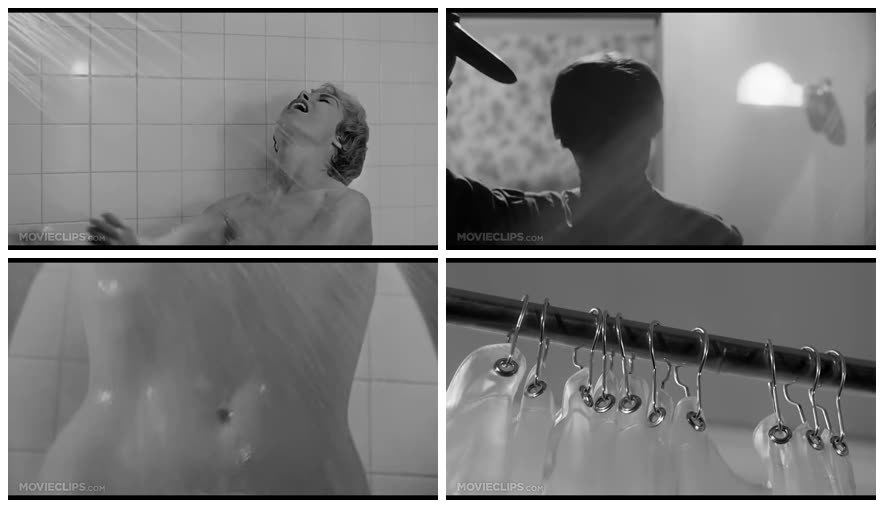
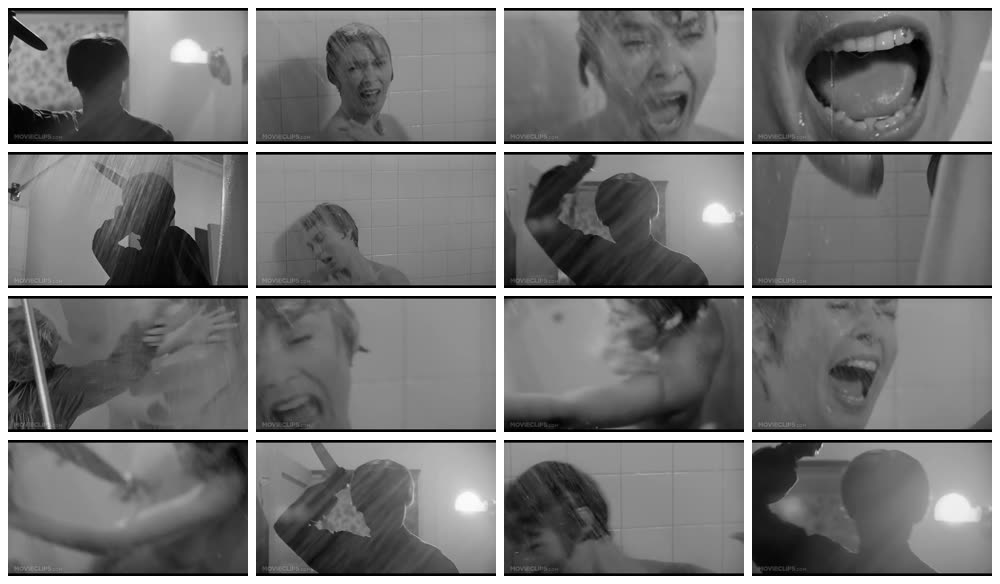
That is not what is on the film. I timed it off a print, frame by frame.2 The cutting is not a texture. It is a spike, and it is a short one: thirty-five cuts inside twenty-three and a half seconds, with a single unbroken shot of nearly sixteen seconds immediately before it and an average shot of five and a half seconds immediately after. See Figure 1, which puts one frame from each of the sequence's four phases side by side.
And then there is the thing I did not expect, which is the reason this piece exists. I have been measuring this sequence with the same instrument I used on the transformation passage in Sherlock Jr.3 — a scene-score detector, which is to say a number per frame expressing how much that frame differs from the one before it.4 Keaton cuts eight times in a hundred and twenty-seven seconds, and he cuts between a garden and a desert and a lion's den. Hitchcock cuts thirty-five times in twenty-three seconds, between pieces of the same white tiled bathroom. You would expect the instrument to find Keaton's cuts trivially and to drown in Hitchcock's.
It is the other way round. Keaton's eight cuts are all found, cleanly, with nothing spurious, at a threshold of 0.15. At that same threshold four of Hitchcock's thirty-five go missing. To recover all thirty-five the threshold has to come down to 0.06 — and at 0.06 the Keaton passage reports eleven boundaries that are not there. There is no setting at which this instrument reads both films correctly, and the reason is that Hitchcock's cuts are quieter than Keaton's: the median cut in the shower sequence scores 0.227, the median cut in the transformation sequence 0.240, and the quietest shower cut scores 0.073 against 0.150 for the quietest Keaton cut.
Fifteen seconds in which nothing is cut
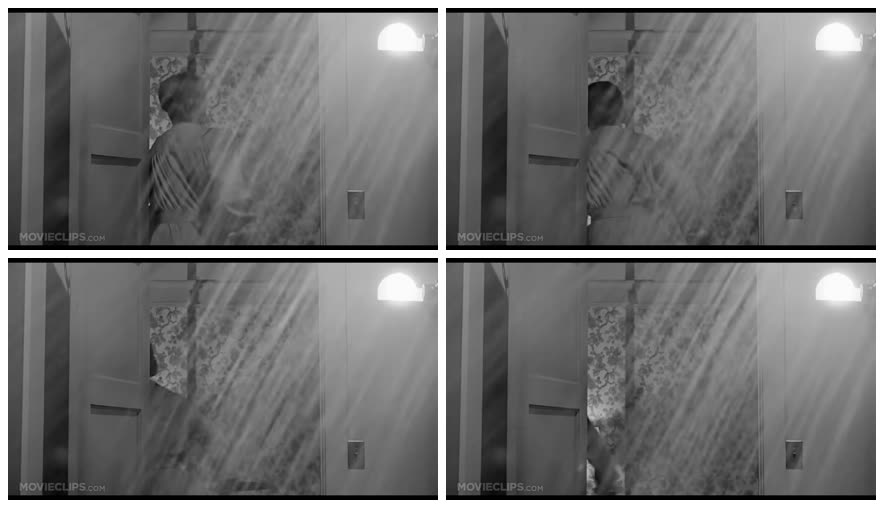
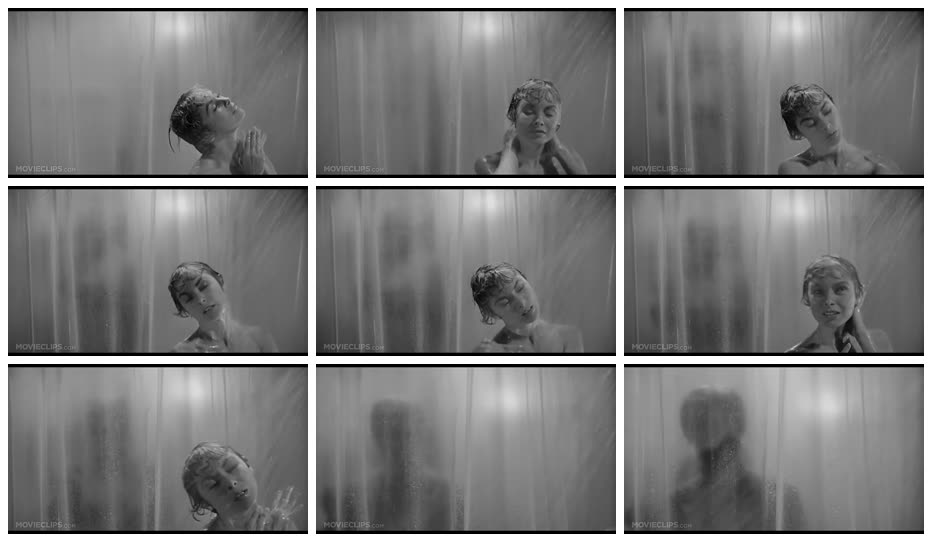
Begin with what the famous number leaves out. The last cut before the attack falls at 42.00 seconds of the clip, and the next one falls at 57.77. Between them is a single shot fifteen and three-quarter seconds long, and it is not merely uncut — it is almost unchanging. Across those 378 frames the largest frame-to-frame score is 0.01, against a median of 0.0004. The camera does not move, the framing does not alter, and Marion washes.
Figure 17 is that shot at nine evenly spaced moments. The curtain is in the same place in all nine. The light at the top right is in the same place. She drifts a little within the frame and in the last two cells she turns away and goes soft behind the curtain, and that is the whole of the event. A viewer who has been told that this scene is forty-five seconds of frenzy has been told something about fifteen of its seconds that is exactly wrong.
What the stillness is for is not mysterious — it is the oldest device there is, and the sequence depends on it absolutely. But it is worth insisting on the measurement rather than the intuition, because the intuition is what produced the received description. The shot is not merely long. It is the quietest fifteen seconds in the reel.
Thirty-five cuts, and what they are cuts between
The attack opens at 57.77 with a cut to the figure in the doorway, knife already up, and closes at 81.33 with a cut away to the held hand. Between those two boundaries are thirty-four complete shots. Table 1 lists them. The durations are measured, not estimated: each boundary was found by reading contact sheets of every single frame between 58.6 and 82.6 seconds, and then checked against the detector.2
| # | What is on screen | In | Frames | Duration |
|---|---|---|---|---|
| 1 | the figure in the doorway, knife up | 57.77 | 25 | 1.043 s |
| 2 | Marion turning, the mouth opening | 58.81 | 15 | 0.625 s |
| 3 | closer: the scream | 59.43 | 16 | 0.668 s |
| 4 | the mouth, extreme close-up | 60.10 | 15 | 0.625 s |
| 5 | the figure, arm rising through the water | 60.73 | 21 | 0.876 s |
| 6 | Marion, the arm swinging into frame | 61.60 | 16 | 0.668 s |
| 7 | the figure against the lamp | 62.27 | 12 | 0.500 s |
| 8 | a pale blur: curtain and forearm | 62.77 | 10 | 0.417 s |
| 9 | hands and forearms, the grapple | 63.19 | 19 | 0.793 s |
| 10 | Marion screaming, sliding out of frame | 63.98 | 25 | 1.042 s |
| 11 | the knife drawn across the forearm | 65.02 | 35 | 1.460 s |
| 12 | the mouth again | 66.48 | 23 | 0.959 s |
| 13 | the blade at the shoulder | 67.44 | 18 | 0.751 s |
| 14 | the figure stabbing, lamp behind | 68.19 | 18 | 0.751 s |
| 15 | her head, blurred, against tile | 68.94 | 15 | 0.626 s |
| 16 | the figure again | 69.57 | 12 | 0.500 s |
| 17 | a forearm across white tile | 70.07 | 12 | 0.500 s |
| 18 | her head against the lamp | 70.57 | 17 | 0.710 s |
| 19 | a hand flat on the tile | 71.28 | 20 | 0.834 s |
| 20 | head and lamp, the knife coming down | 72.11 | 8 | 0.333 s |
| 21 | her face against the tile | 72.45 | 11 | 0.459 s |
| 22 | head and lamp, the gloved hand | 72.91 | 8 | 0.334 s |
| 23 | the blade at the midriff | 73.24 | 8 | 0.333 s |
| 24 | her face, eyes shut | 73.57 | 9 | 0.376 s |
| 25 | the knife against a white wall | 73.95 | 11 | 0.459 s |
| 26 | the figure, water, almost black | 74.41 | 9 | 0.375 s |
| 27 | Marion screaming, arm raised | 74.78 | 14 | 0.584 s |
| 28 | the feet in the tub | 75.37 | 28 | 1.168 s |
| 29 | her face turning away | 76.54 | 12 | 0.500 s |
| 30 | Marion against the tile wall | 77.04 | 10 | 0.417 s |
| 31 | the body beginning to slide | 77.45 | 21 | 0.876 s |
| 32 | the splayed hand on tile | 78.33 | 19 | 0.793 s |
| 33 | her head going down the wall | 79.12 | 27 | 1.126 s |
| 34 | the wide shower, the figure leaving | 80.25 | 26 | 1.084 s |
| Total | 23.57 s | |||
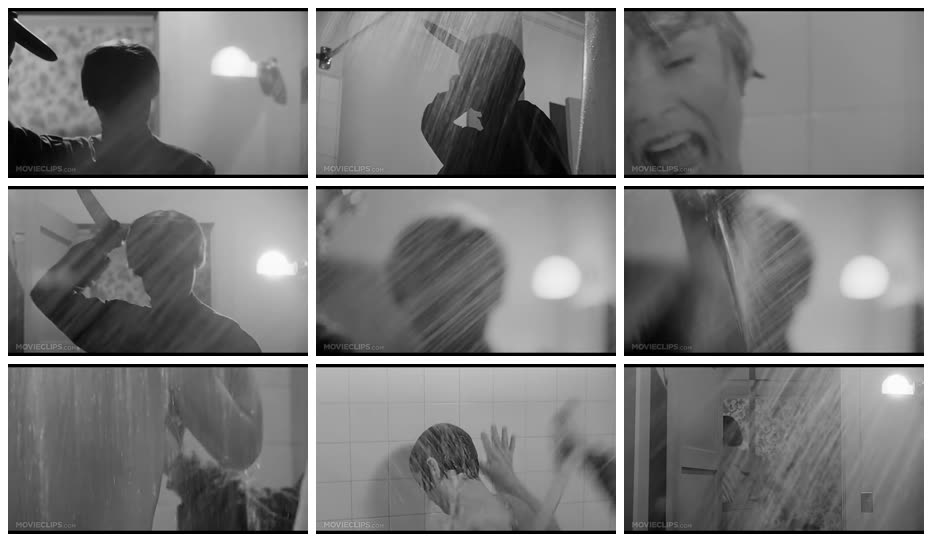
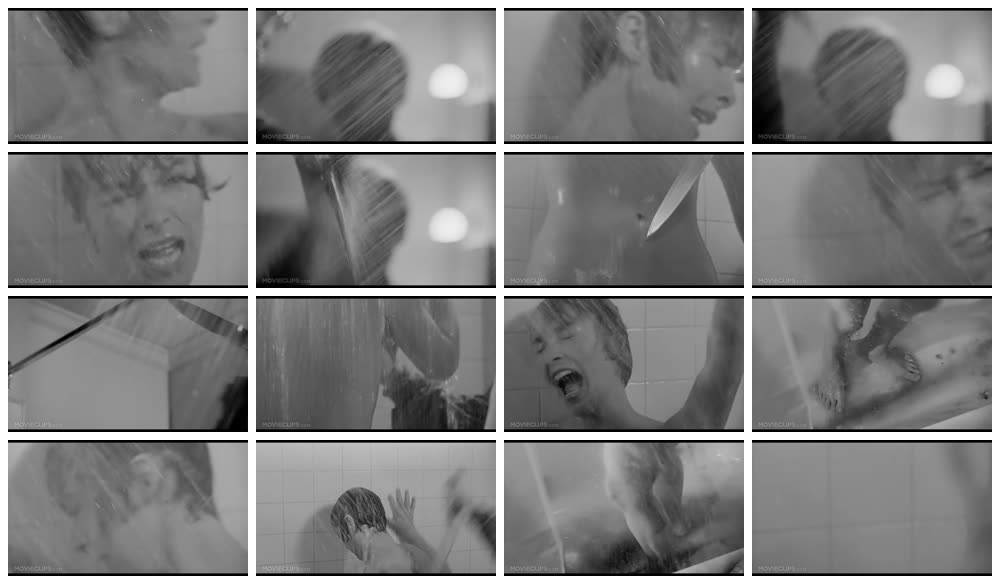
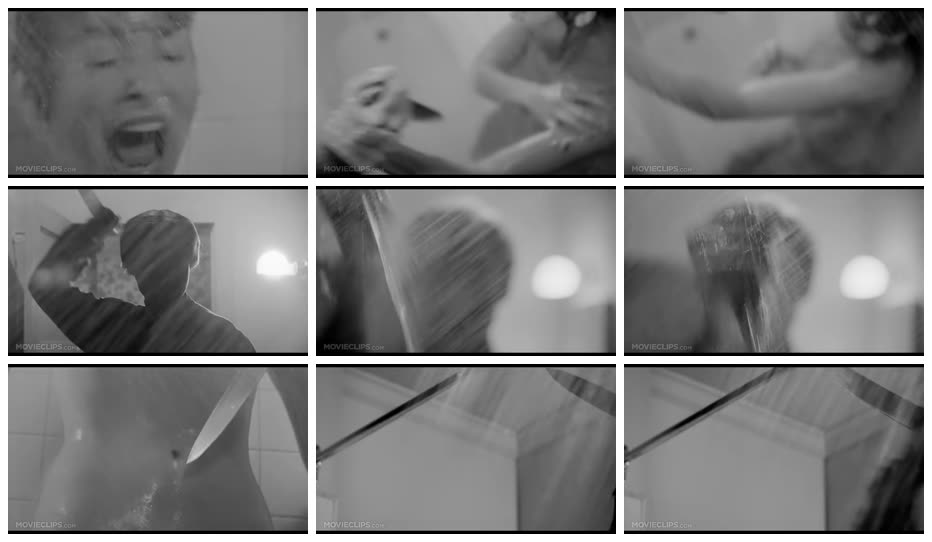
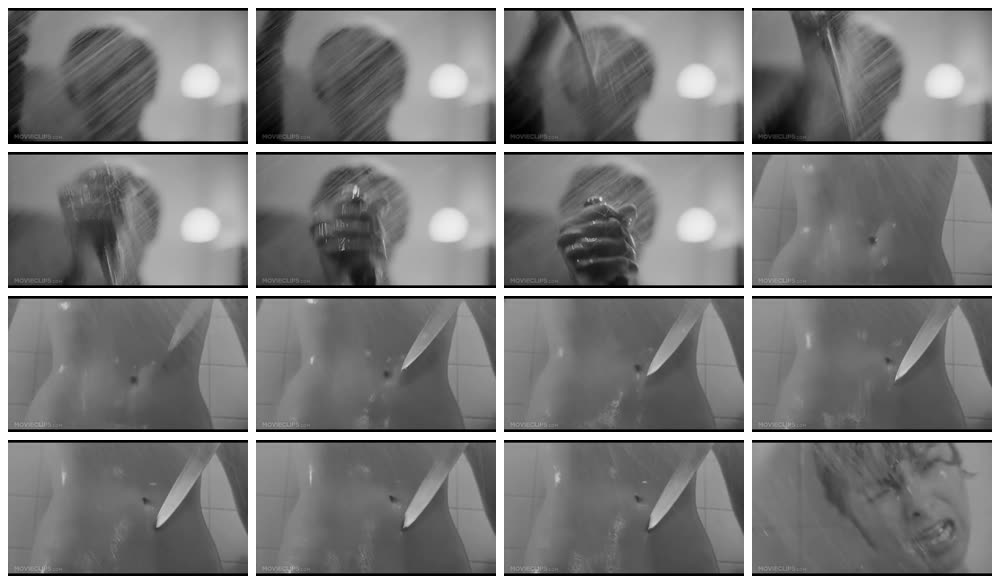
Figures 5 and 6 are the list made visible: one frame from the middle of each of the first sixteen shots, and then one from each of the next sixteen. Look at them as a pair and the first thing that is obvious is also the thing the received description denies. These are not thirty-two views of the same event. They are thirty-two different pictures — a mouth, a shoulder, a doorway, a forearm, a pair of feet, a wall — and no two consecutive cells show the same framing. The sequence is not a blur of one thing. It is an inventory.
The inventory is what makes the cutting legible at speed, and it is worth being precise about the mechanism, because it is the opposite of what the "too fast to see" description assumes. A cut between two similar framings is hard to read; the eye has to work out what moved. A cut between two dissimilar framings is read instantly, because there is nothing to reconcile — the second image simply replaces the first. Hitchcock cuts between dissimilar framings every time, which is why a third of a second is enough. Figure 2 takes nine shots spread across the whole attack and makes the same point at a coarser grain.
The tempo is not flat
Thirty-four shots, 23.57 seconds, a mean of 0.693 seconds and a median of 0.647. But the mean conceals a shape. Taken in thirds, the attack runs 0.792 seconds per shot, then 0.614, then 0.674: it accelerates into its middle and decelerates out of it. The fastest cutting is not at the climax. It is in the second eight seconds, and by the end the shots are lengthening again while Marion is still being killed.
The extremes are further apart than the famous number suggests. Nine of the thirty-four shots are under half a second and seven are under ten frames, but the longest runs thirty-five frames — a second and a half, which in this context is an eternity. Figure 8 is that shot, four moments from the knife being drawn down the forearm: one continuous movement, held. Figure 7 is the shortest, eight frames of head and lamp with the blade coming down, which at projection speed is a third of a second and reads as a single impression rather than as a shot at all. The two are adjacent in kind and twenty-seven frames apart in length.
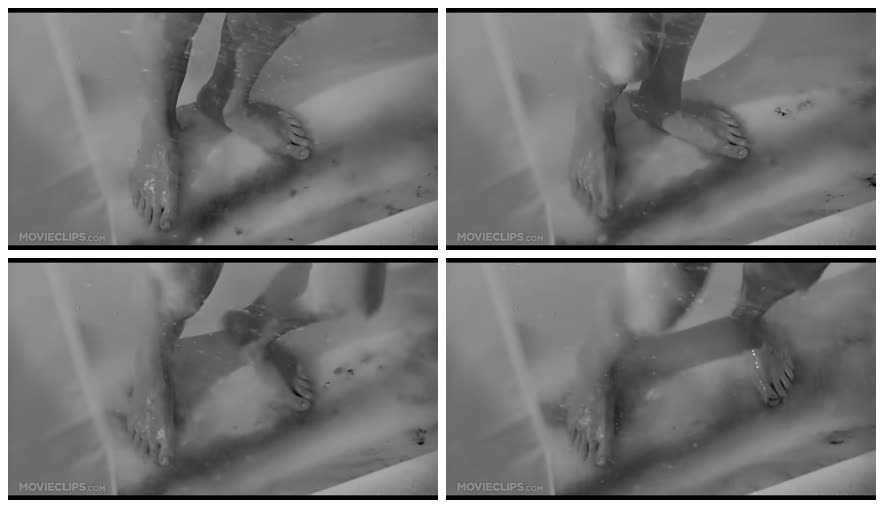
Between them sit the three shots that give the passage its floor: the feet in the tub at twenty-eight frames (Figure 11), the slide down the wall at twenty-seven, and the wide shot of the empty shower at twenty-six. Each is more than a second. Each arrives when the knife is not in frame. The sequence breathes, and it breathes on a schedule.
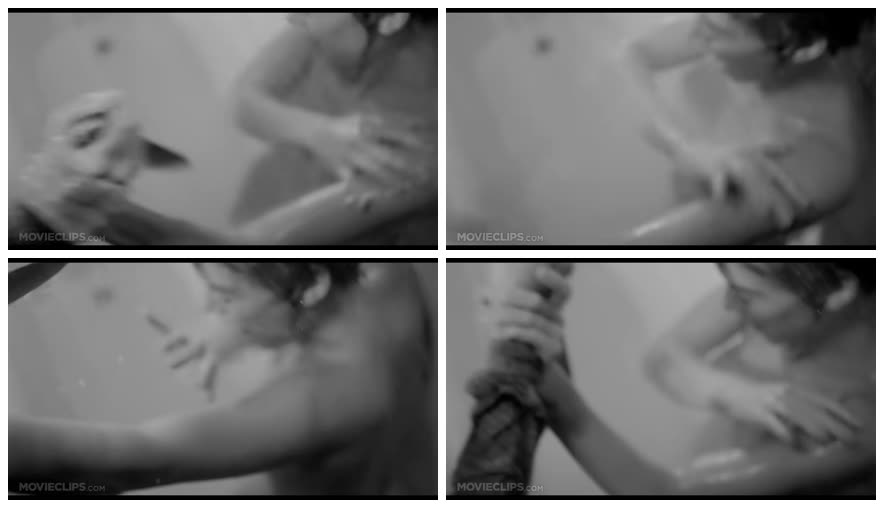
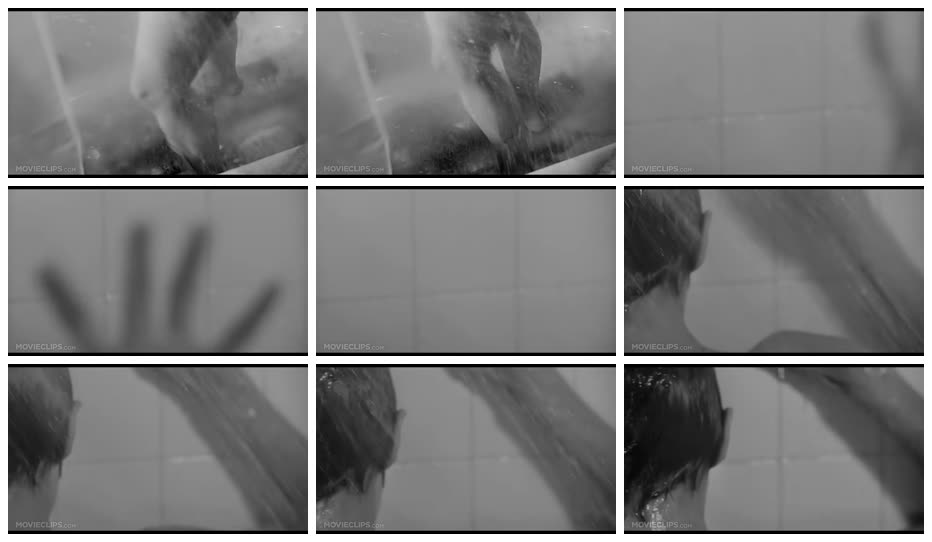
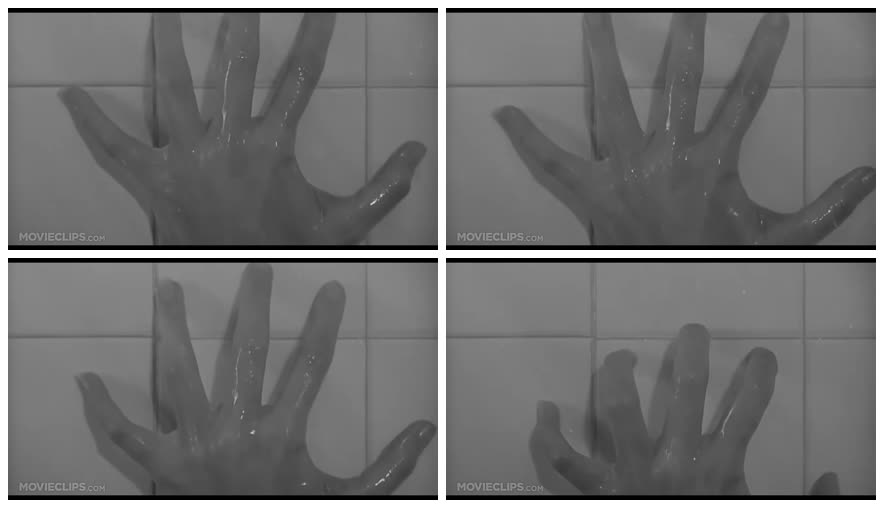
Figures 12 and 13 follow what happens once the knife has gone: the body going down the tile over nine frames spread across three shots, and then the hand, splayed, sliding. Figure 15 is the departure, Figure 16 the hand held after everything has stopped. The deceleration is not an accident of coverage. It is the second half of a two-part structure whose first half was the fifteen-second take.
What the instrument sees
Now the measurement that reversed my expectation. Table 2 is the detector run over the attack at nine thresholds, scored against the hand-read list in Table 1.
| Threshold | Frames flagged | Cuts found | Missed | Spurious |
|---|---|---|---|---|
| 0.30 | 10 | 10 | 25 | 0 |
| 0.25 | 15 | 15 | 20 | 0 |
| 0.20 | 24 | 24 | 11 | 0 |
| 0.15 | 32 | 31 | 4 | 0 |
| 0.12 | 33 | 32 | 3 | 0 |
| 0.10 | 38 | 34 | 1 | 0 |
| 0.08 | 41 | 34 | 1 | 0 |
| 0.06 | 52 | 35 | 0 | 1 |
| 0.05 | 60 | 35 | 0 | 4 |
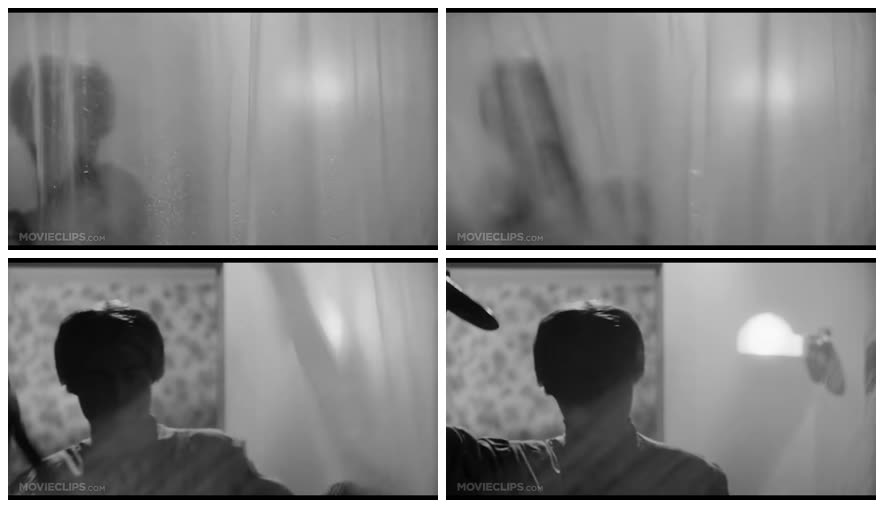
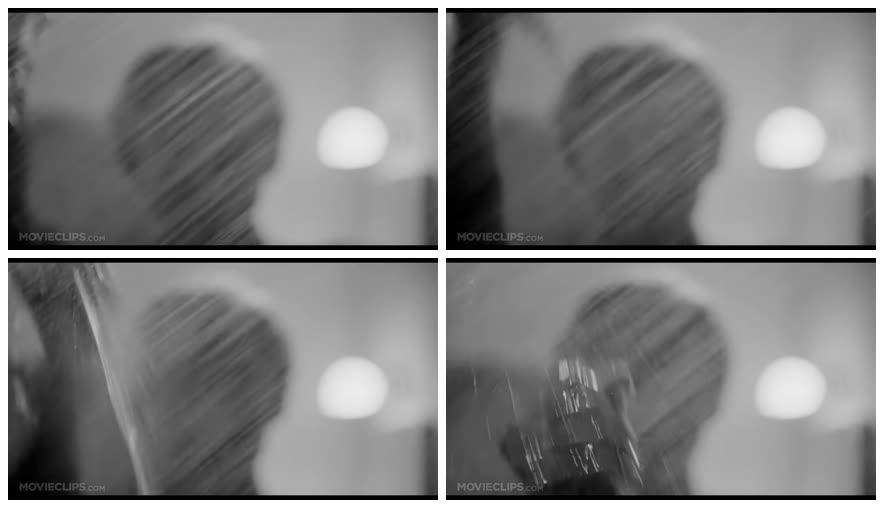
At 0.30 — a conventional setting, and the one at which the Keaton sequence gives up nine of its ten boundaries when the detector is pointed at the screen rectangle alone3 — this sequence yields ten cuts of thirty-five. Seventy per cent of the cutting is invisible. The threshold has to fall to 0.06 before the list is complete, and the last cut to arrive is the first one, the cut to the figure in the doorway at 57.77, which scores 0.073.
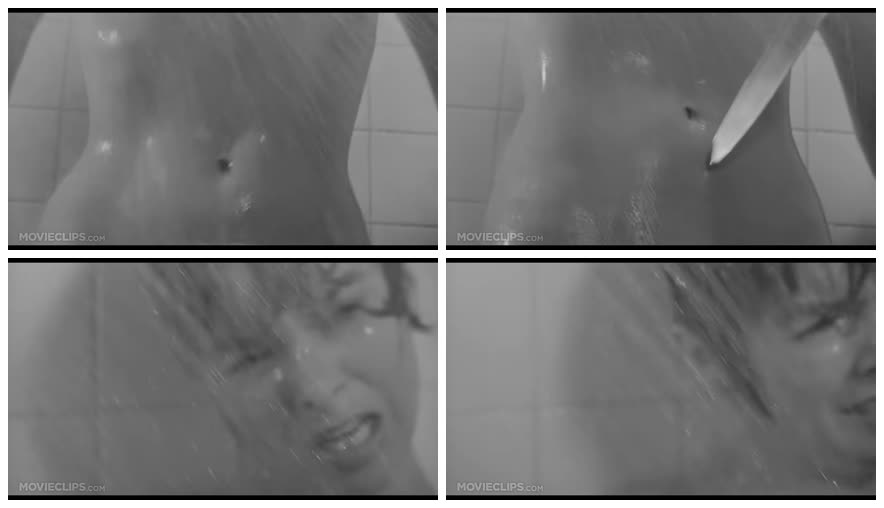
Figure 3 is that cut: two frames before and two after. It is a cut from a wet curtain with a dark shape behind it to a sharp close shot of the back of a head against wallpaper, and it is, to the eye, unmistakable. To the instrument it is the faintest event in the passage, because the frame before it was already mostly dark and mostly out of focus, and the frame after is mostly dark too. I nearly missed it myself on the first pass through the contact sheets, which is a coincidence worth recording: the cut that is hardest for the measure is also the one that is hardest to see in a grid of still frames, and for the same reason.
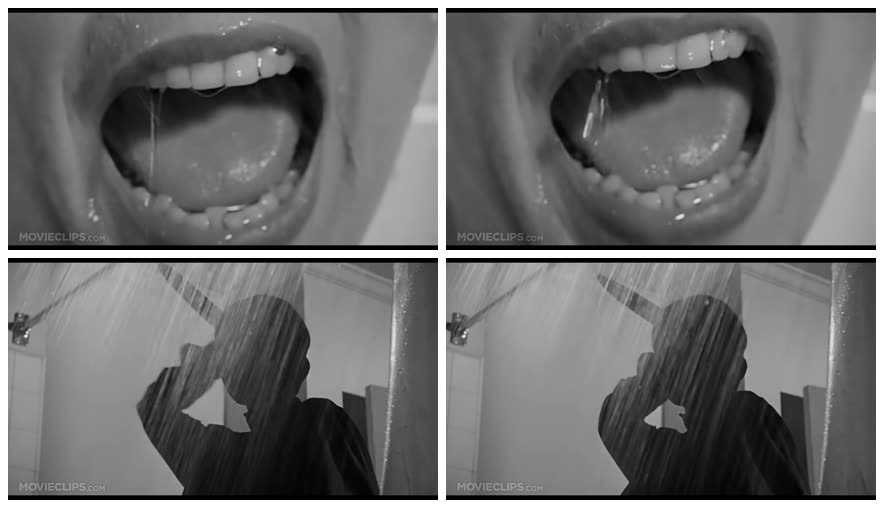
Figure 10 is the second-quietest, at 0.106 — a cut from a blade against white tile to a face with its eyes shut. Figure 4 is the loudest in the passage at 0.451, and it is instructive precisely because it is not the most violent moment in the sequence: it is the cut out of the mouth in extreme close-up, a pale image filling the frame, into the figure, which is very nearly black. The difference between the loudest cut and the quietest is not a difference in how violent they are or how fast they arrive. It is a difference in how much black there is on each side. Six to one, as the instrument scores it, between two cuts that a viewer would not rank differently at all.
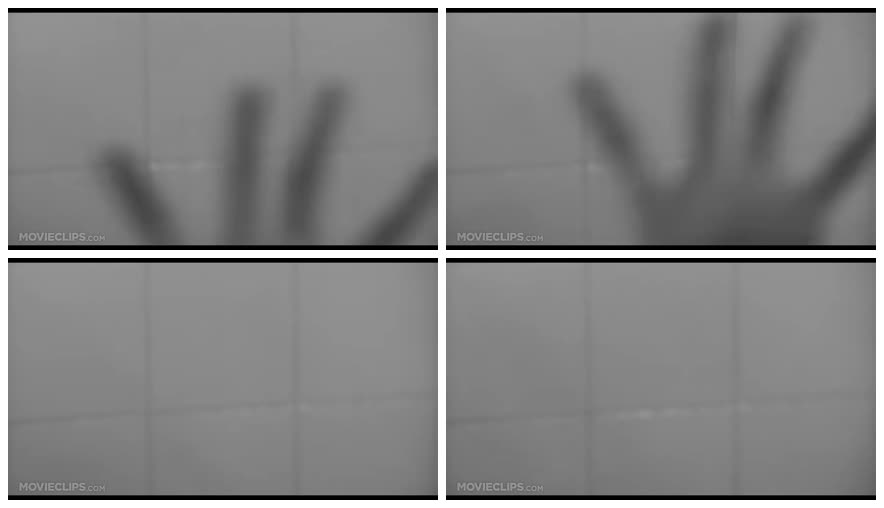
And none of them is a dissolve. Figure 14 is sixteen consecutive frames spanning the cut at 73.24 — eight before and eight after, every frame, nothing skipped. There is no transition frame, no overlap, no softening. The eighth cell is the old shot and the ninth is the new one. Every one of the thirty-five boundaries in this sequence is of that kind, which is worth stating because the sequence's reputation for being a blur invites the assumption that something is being smeared. Nothing is. Figure 9 collects nine frames in which the blade is visible; across the whole attack it is in frame for well under half the running time.
The quiet cut
Why should this sequence be harder to measure than a sequence of a man falling off a cliff into a lion's den? Table 3 puts the two side by side.
| Psycho, the attack | Sherlock Jr., the transformation | |
|---|---|---|
| length | 23.57 s | 127.26 s |
| cuts | 35 | 8 |
| mean shot | 0.69 s | 13.14 s |
| median score at a cut | 0.227 | 0.240 |
| quietest cut | 0.073 | 0.150 |
| mean interior score | 0.0096 | 0.0043 |
| loudest interior frame | 0.062 | 0.101 |
| clean threshold window | none | 0.12 – 0.15 |
| all cuts found at | 0.06 | 0.15 |
| spurious at that setting | 1 | 0 |
Two numbers do the work. The quietest cut in the shower sequence scores 0.073, half the quietest cut in the Keaton; and the mean score inside a shower shot is 0.0096, more than twice the mean inside a Keaton shot. Hitchcock's signal is smaller and his noise is larger. The signal is smaller because he is cutting between pieces of one white bathroom under one lighting setup, so the grey level barely moves across a boundary however different the framings are. The noise is larger because every shot is full of violent movement, water and a hand-held camera, so the grey level is moving constantly within a shot as well.
Keaton's sequence has the opposite shape. His cuts are between a garden and a city street and a desert, which are different in every respect a histogram can measure, so each boundary is loud. His shots are long and almost static — a man standing still while a world holds behind him — so between the boundaries almost nothing happens. Loud signal, quiet noise: the easy case, and 0.12 to 0.15 reads it perfectly.
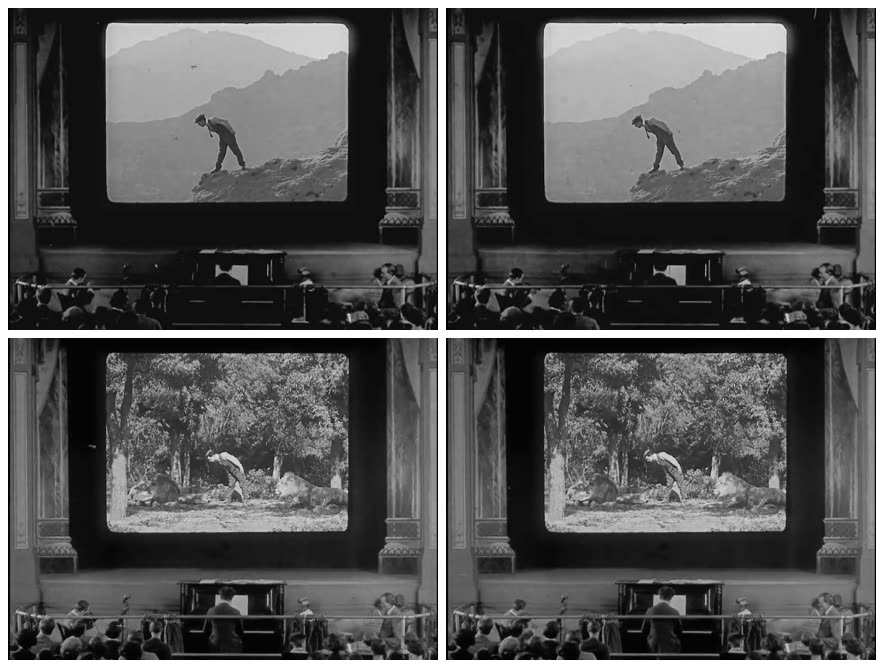
The one Keaton cut that takes real work is the fourth, from the cliff edge to the lion's den, and Figure 18 shows why: two frames before and two after, and the man's body is in the same posture and the same position in the frame on both sides. It is a matched cut, and Keaton's sequence is built out of them. The instrument still finds it, at 0.256, but it finds it four frames late — the score does not peak until the lions have begun to move and the match has broken. That is the general behaviour of a matched cut under this measure, and it is why Table 2's tolerance is stated in frames rather than assumed to be zero.
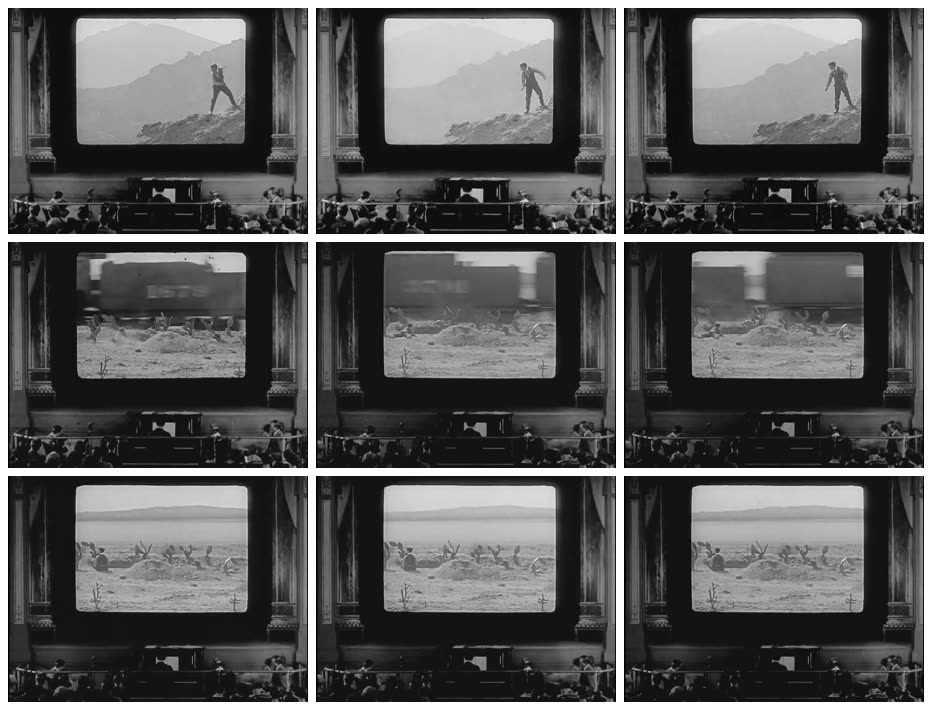
Push the threshold down to the 0.06 the shower sequence requires, and the Keaton passage reports eleven boundaries that are not boundaries at all. Figure 19 takes three of them — one frame before, the flagged frame, one frame after. Nothing happens in any of the three. They are frames in the middle of a shot, and what the detector is reacting to is not in the photography. Six of the eleven fall inside a single shot, the desert, and when the scores inside a shot are tested for periodicity the strongest component sits at exactly sixty-eight frames in three of the four shots long enough to test.5 A period that recurs across four shots of different content is not a property of what was photographed. It is a property of the copy.
What this does to the received idea
The shower sequence's reputation rests on a count, and the count is roughly right: thirty-five cuts in the attack proper, more if you take the whole scene from the moment the water starts to the moment the camera finds the drain. What the count has been made to mean is wrong in three ways that the measurements above settle.
It is not forty-five seconds of cutting. It is twenty-three and a half, bracketed by a fifteen-and-three-quarter-second shot in which the frame-to-frame difference never exceeds 0.01 and by a decelerating tail whose first three shots all run over a second. The famous rate is a local maximum, and it is surrounded, deliberately, by its own opposite.
It is not a blur. Thirty-two consecutive shots, as Figures 5 and 6 lay them out, are thirty-two distinguishable pictures of thirty-two different things, and the reason a third of a second suffices for any of them is precisely that no two adjacent framings resemble each other. The speed is legible because the images are dissimilar; it is not legible in spite of the speed.
And it is not, by the only measure I have applied to both, more violent per cut than a Keaton gag. Every boundary in this sequence registers at or below the median boundary in the transformation passage of Sherlock Jr., and the quietest registers at half. A sequence can be the fastest thing in the movies and, cut for cut, among the gentlest things an instrument can be asked to find.
That last point is the one I would keep. The thing that makes the shower scene feel like an assault is not the magnitude of its ruptures — they are small — but their rate, their dissimilarity, and the fifteen still seconds that precede them. All three are decisions about arrangement. None of them is a decision about force.
Note on the clip and the measurements
Everything above is measured from a single excerpt, and the numbers are properties of that excerpt before they are properties of the film.1 Times are given as seconds within the clip rather than as film timecodes, because the clip is an extract and its zero is not the film's. The cadence is the film's own, which is what makes the frame counts in Table 1 meaningful.6 The cut list was read off contact sheets of every frame and then checked against the detector, in that order and not the other;2 one shot was flagged by the check and inspected again, and it is a single shot.7 Two claims here could be overturned by a better source: the exact scores, which depend on the encode as note 5 shows they can, and the status of the first cut at 57.77, which is the faintest event I am calling a cut and which a cleaner transfer might make louder or might not. The plates are frame enlargements reproduced for criticism and comment.8
What I have not done is extend the hand-read list beyond the attack. The drain, the eye and the long dissolve between them are a separate problem and a slower one — seven boundaries in the thirty-nine seconds that follow — and they want a different instrument than the one used here.4
Plates
Notes
The received figure — seventy-eight camera setups and fifty-two cuts — comes from the production literature rather than from a count of the finished film, and it is a figure about how the sequence was shot as much as about how it was assembled. The clip measured here is the licensed excerpt of the sequence published by Movieclips, 1280 by 720, 201.74 seconds, carrying the sequence from the bedroom through to the aftermath. It is an extract, so its zero is not the film's and no timecode in this piece should be read against a print. ↩ ↩
The method, in order: contact sheets of every frame between 58.6 and 82.6 seconds, sixty-four frames to a sheet, read by eye; then the resulting list checked against the detector, both for cuts the eye had placed where the instrument saw nothing and for high-scoring frames inside what the eye had called one shot. One cut was added on the second pass — the first one, at 57.77, which fell outside the window the sheets covered, and which is also the faintest. That is the order that matters: a list read off a detector and then confirmed by eye will inherit the detector's blind spots, because the eye is only ever shown the places the instrument already chose. ↩ ↩ ↩
The companion piece, Keaton Sits Still, measures the two minutes of Sherlock Jr. in which a projectionist is thrown through eight worlds without getting up. Its central finding bears directly on the comparison here: because the sequence is staged as something seen from an auditorium, roughly two-thirds of every frame is a theatre that does not change, and each cut therefore registers about half as much over the whole frame as over the screen rectangle alone. The figures quoted in this piece for Sherlock Jr. are whole-frame figures, which is the like-for-like comparison with a sequence that has no such frame-within-a-frame. ↩ ↩
The measure is a normalised frame-difference score: for each frame, how much its distribution of brightness departs from the previous frame's, on a scale where 0 is identity and 1 is total dissimilarity. It is cheap, it is the default in most toolchains, and it is blind to everything a viewer uses — it does not know about objects, motion, faces or composition, only about how much grey of each shade is present. That blindness is the point of using it: it makes the measurement reproducible and it makes its failures diagnostic. It is also the reason it is the wrong instrument for the passage after the attack, where the drain becomes an eye by a slow dissolve and a frame-difference measure sees a gradual change rather than a boundary. ↩ ↩
Autocorrelation of the per-frame score inside each of the four Sherlock Jr. shots long enough to test puts the strongest component at a lag of exactly sixty-eight frames in three of them — the cliff, the desert and the snowbank — and the same lag appears, weaker, in the fourth. Sixty-eight frames is 2.836 seconds at this cadence. Two of the three highest-scoring spurious frames coincide with keyframes of the encoded file, which would explain a shift in the brightness distribution at a point where nothing in the photograph changes, but keyframes do not account for the sixty-eight-frame period and I am not going to pretend to know what does. The negative control is the useful part: the same test on the fifteen-second unbroken take in Psycho finds no comparable component, with a strongest correlation of 0.02 against 0.15 to 0.30 for the Keaton shots. Whatever it is, it is in that copy and not in the other. ↩
The clip runs at 24000/1001 frames per second, the standard broadcast rendering of twenty-four — so a frame count here is a frame count of the film, not of a transfer that has resampled it. This matters more than resolution for everything in Table 1: a sequence conformed to thirty frames per second would carry duplicated frames, and a shot of eight frames would be unmeasurable as such. It is why this excerpt was preferred to two higher-resolution ones. ↩
Shot 11, the thirty-five-frame shot in which the knife is drawn down the forearm, carries an interior frame scoring 0.075 — higher than the quietest true cut in the passage. Inspected frame by frame it is plainly continuous: the blade moving across a pale arm, no change of framing, no change of position. It is the single clearest demonstration in this material that the measure cannot separate a cut from a movement, and it is also the reason the separation figure in Table 3 is quoted against the loudest interior frame rather than against a percentile. ↩
The plates are frame enlargements from a licensed excerpt, reproduced here for criticism and comment, at a size and resolution suited to reading an argument about cutting and useless for any other purpose. Each is a grid rather than a single still because the claims being made are about relations between frames — before and after a boundary, across a shot, across a sequence — and a relation cannot be shown with one picture. ↩
Shot By Shot is published by Exploded Views Media. Plates are frame enlargements reproduced for criticism and comment. Measurements and tables may be reused with attribution.