Keaton Sits Still
The cut as antagonist in the projection-booth sequence of Sherlock Jr. — a shot-by-shot reading of the two minutes in which a projectionist walks into a film and is thrown through eight worlds without once getting up.
Nineteen and a half minutes into Sherlock Jr. (1924)1 a projectionist falls asleep over his machine, and a second, translucent Keaton gets up out of the first one, walks down the aisle of his own cinema, and climbs into the picture he has been running. The audience in the stalls does not turn round. The orchestra keeps playing. He steps over the footlights and into a drawing room, where the villain of the film-within-the-film takes him by the collar and throws him out of the front door.
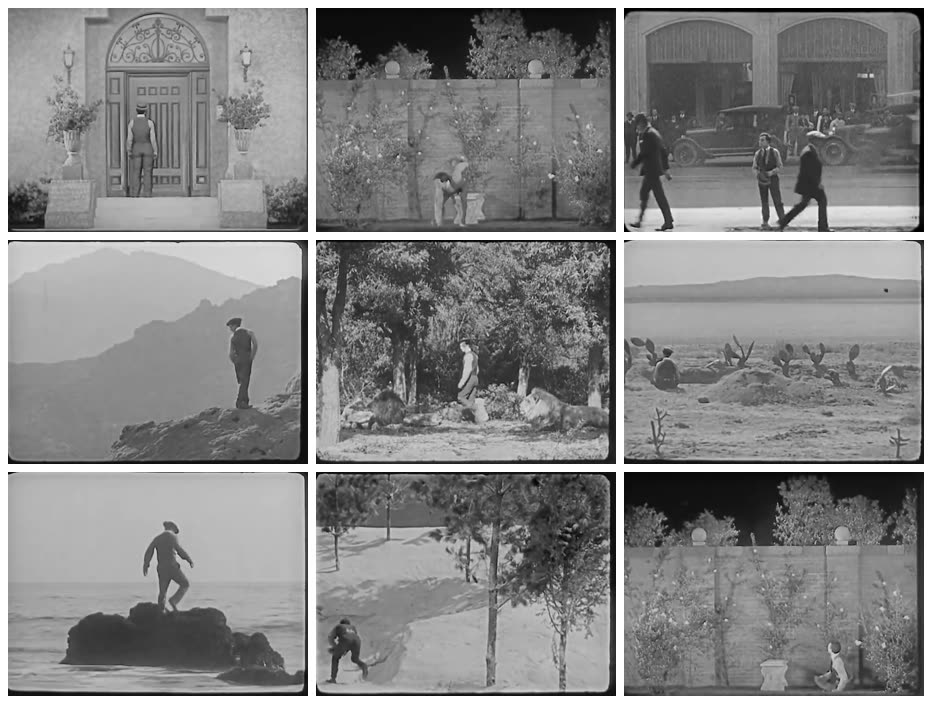
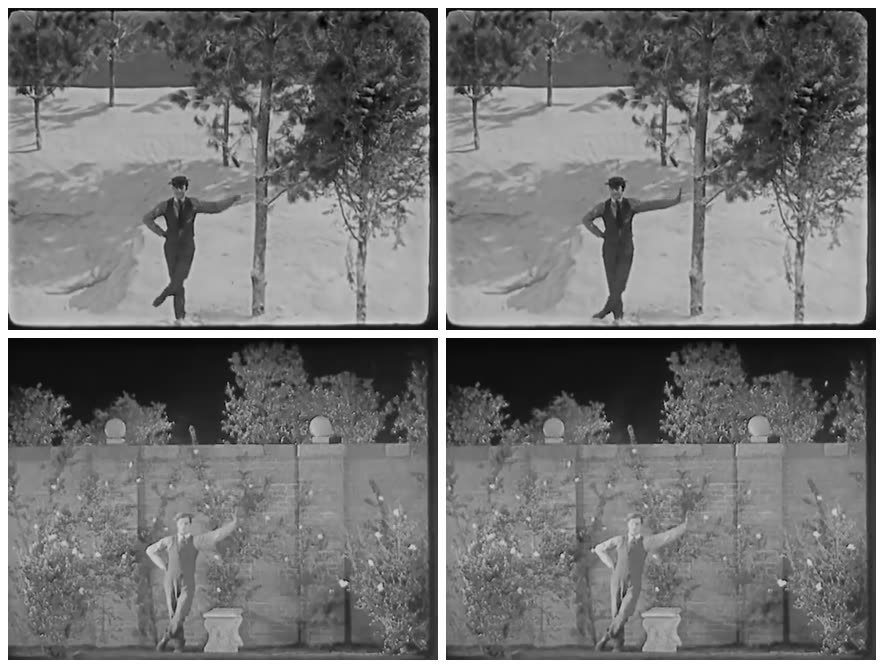
What follows is the passage everybody remembers, and it is worth being exact about what it does. Over the next hundred and eighteen seconds2 Keaton is moved through eight settings — a garden, a city street, a cliff edge, a lion's den, a desert, a rock in the open sea, a snowbank, and the garden again — without ever walking from one to the next. Each time, he commits to a physical action appropriate to where he is; each time, the cut substitutes a different world underneath the action; and each time he arrives in the new world already mid-gesture, with the gesture now disastrously wrong. He sits down on a garden bench and lands on a city kerb. He leans against a rock on a cliff and finds himself among lions.
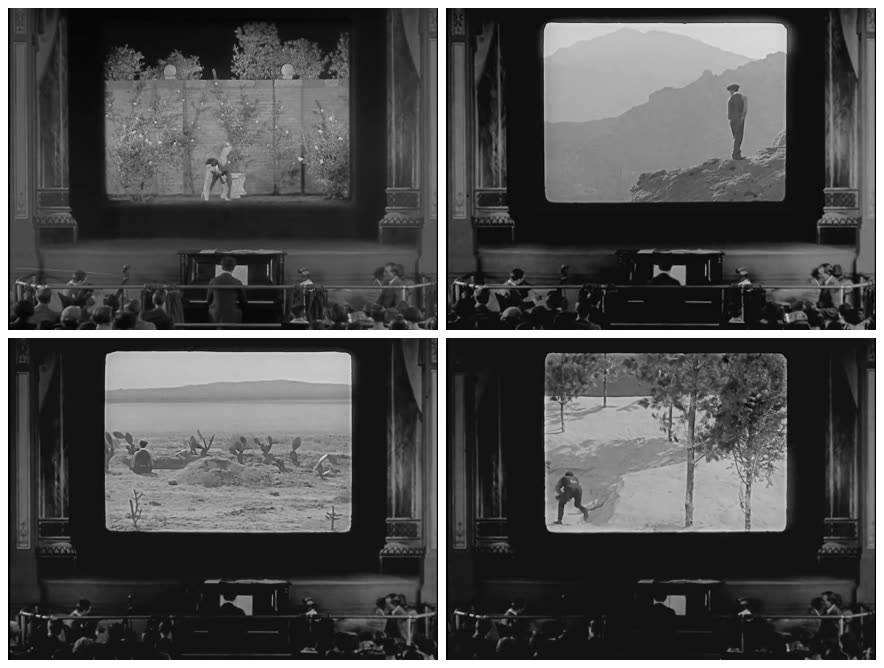
The usual way of describing this is that Keaton is a victim of the edit. That is right, and it is not quite enough, because it leaves out the strangest thing about how the passage is staged. We are not inside the film with him. We are watching it from the auditorium, in the fifth row, with the backs of other people's heads at the bottom of the frame and the proscenium arch down both sides. The joke is not that he is in a movie. The joke is that he is in a movie and we can still see the theatre. See Figure 1, which puts four of the eight worlds side by side as the camera actually frames them, and Figure 2, which strips the theatre away and shows the worlds in order.
The theatre does not leave
The screen occupies a rectangle measuring 550 by 410 pixels in a frame of 960 by 720 — a little under a third of the picture area — and across all eight world shots that rectangle does not move.3 The other two-thirds is a permanent, unchanging photograph of a room: gilt pilasters, a curtain, an orchestra rail, a conductor's head, a few dozen patrons in silhouette. Nothing in that two-thirds responds to anything that happens in the other third. Lions appear nine feet from the front row and the front row does not move.
This is the formal decision the sequence is built on, and it has a measurable consequence that I did not expect to find and will come back to below. For now it is enough to say what it does to the viewer: it refuses to let the dream become a film we are simply watching. Every one of Keaton's humiliations is delivered to us as something happening on a screen, in a room, to a man who should not be in there — which is a more complicated position to occupy than simple absorption, and much funnier.
Eight worlds, and how long each one lasts
Table 1 gives the sequence as measured: the eight shots between the cut out of the doorway and the cut back to the parlour, with the time each one holds.4 It is not a fast sequence. The mean shot runs just under fifteen seconds, which is long by any standard and very long for a passage whose reputation is for whiplash. What is fast is not the cutting rate but the rate of total substitution: every fifteen seconds the entire visible world is replaced, and nothing carries over but the man.
| # | World | In | Out | Duration |
|---|---|---|---|---|
| 1 | garden, behind a wall | 19:49.10 | 19:58.57 | 9.47 s |
| 2 | city street, traffic | 19:58.57 | 20:10.54 | 11.97 s |
| 3 | cliff edge | 20:10.54 | 20:23.68 | 13.14 s |
| 4 | lion's den | 20:23.68 | 20:38.36 | 14.68 s |
| 5 | desert | 20:38.36 | 21:08.73 | 30.37 s |
| 6 | rock in the open sea | 21:08.73 | 21:24.16 | 15.43 s |
| 7 | snowbank | 21:24.16 | 21:39.63 | 15.47 s |
| 8 | garden, behind the same wall | 21:39.63 | 21:47.26 | 7.63 s |
| Total | 118.16 s | |||
The shape of the column is worth a moment. The first four worlds lengthen steadily — 9.5, 12.0, 13.1, 14.7 — as though Keaton were giving each new predicament slightly more room than the last. Then comes the desert at 30.4 seconds, more than twice the running mean and the only shot in the sequence with a set piece inside it. After the desert the lengths settle at fifteen and a half and then collapse to 7.6 for the return. The sequence does not accelerate towards its climax. It expands to the middle and contracts away from it, which is the shape of a held breath rather than a chase. Figure 2 shows the same worlds as a single plate, where the symmetry is visible at a glance.
The cut as assailant
In every other Keaton picture the antagonist is a physical force with a location: a locomotive, a boulder, a house front, a waterfall, several hundred brides. The antagonist can be outrun, out-thought, or survived by standing in the one place it is not. Here the antagonist is the edit, and the edit has no location. It cannot be outrun because it is not in the world Keaton is running in. It is the thing that replaces that world.
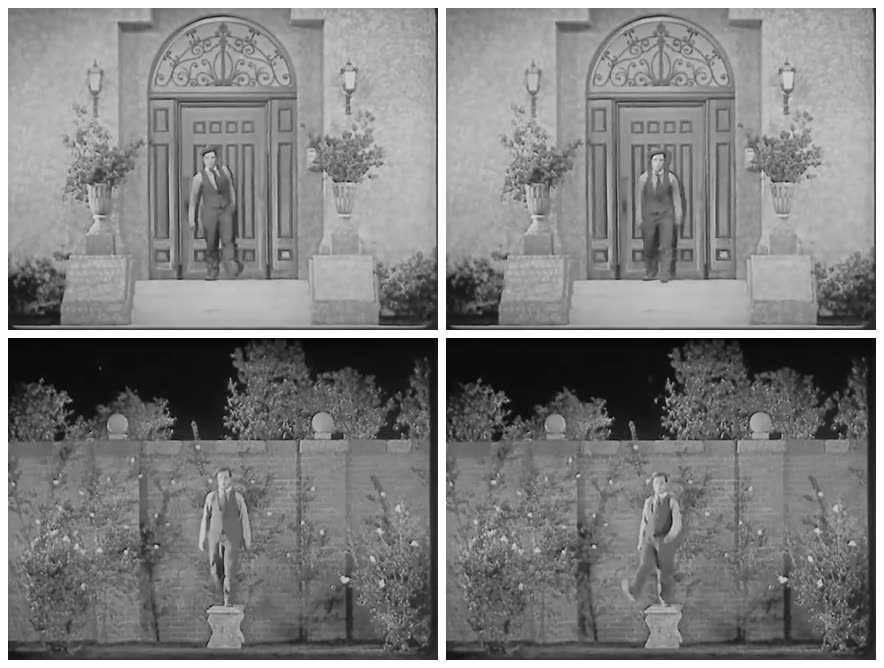
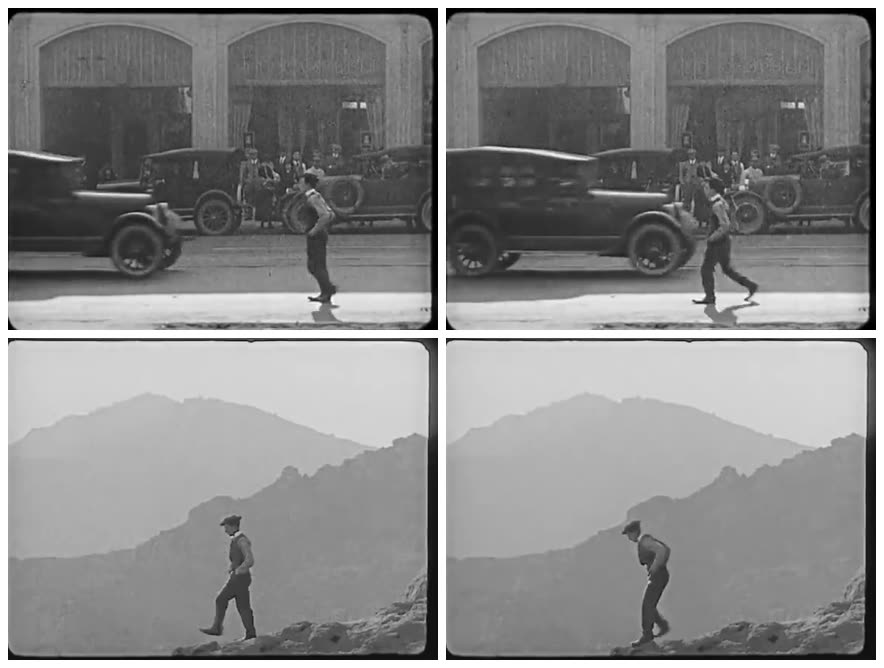
What makes this legible rather than merely conceptual is that Keaton gives the cut a consistent grammar, and the grammar is always the same three beats: he commits his weight, the cut lands, and his commitment becomes an error. Figure 3 shows the first instance. He steps down off the doorstep where the villain has dumped him; the cut arrives between one foot and the next; and he comes down on a stone plinth in a walled garden, mid-stride, still finishing a step whose destination no longer exists.
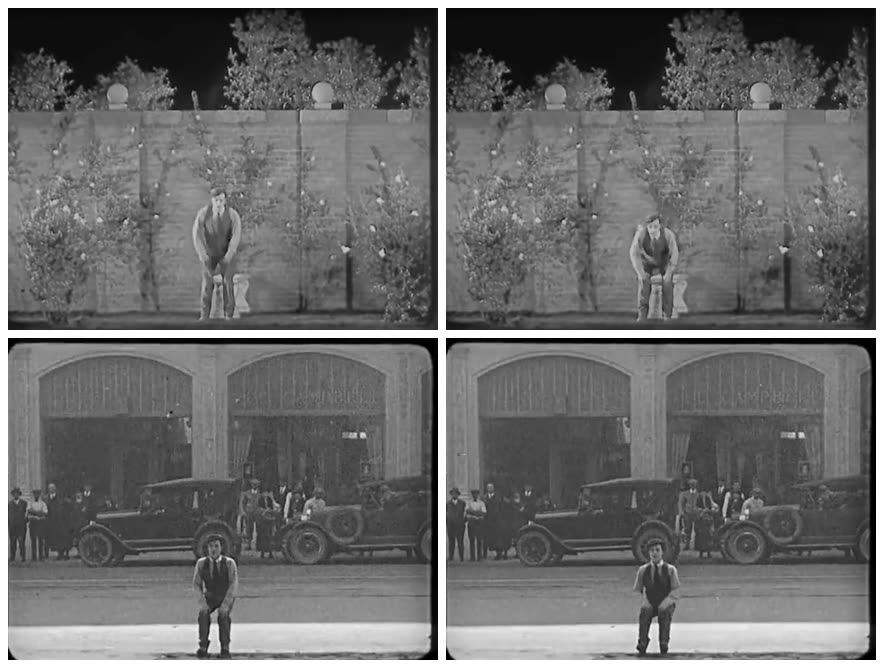
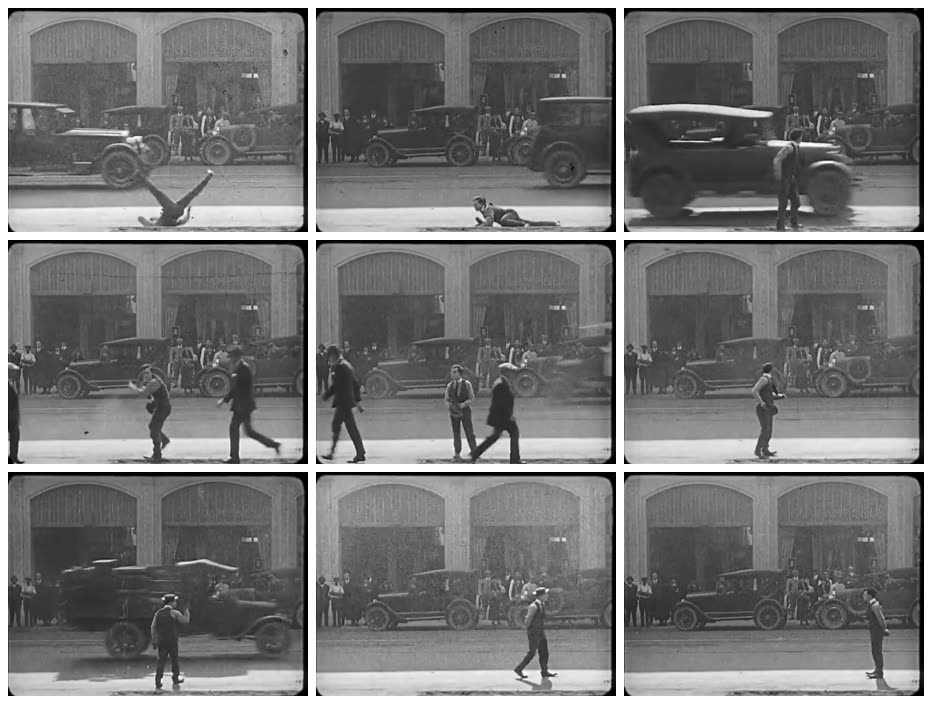
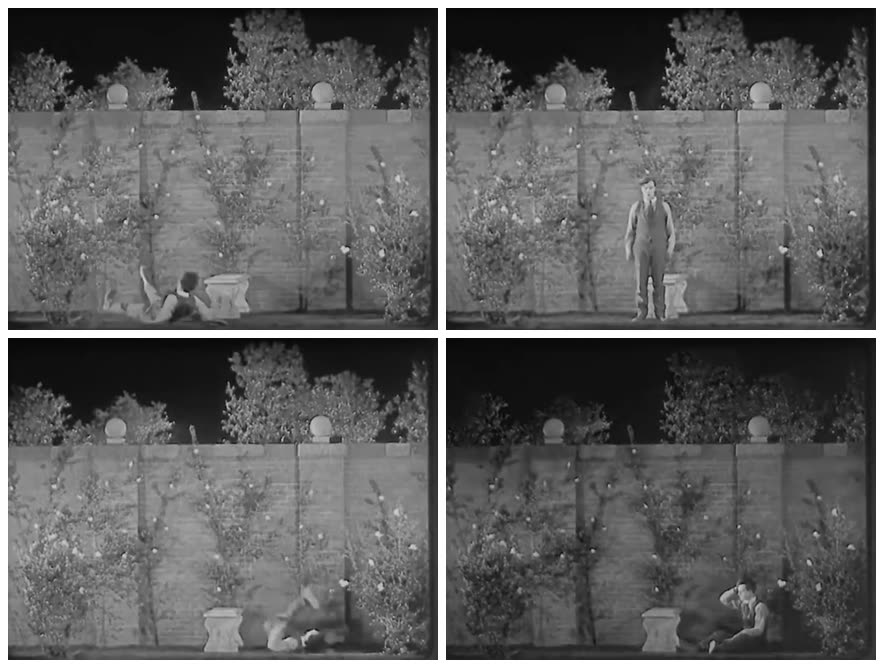
Figure 4 is the second and the most quoted. He has settled onto a garden bench, hands folded; the cut lands; and he is sitting on the kerb of a busy street with motor traffic crossing the frame a yard from his knees. He does not startle. He looks mildly put out, as a man does when a bus is late. The whole method of the gag depends on his refusing to acknowledge that anything impossible has occurred — if he registered the cut as miraculous, it would become a trick film, and tricks are not funny twice.
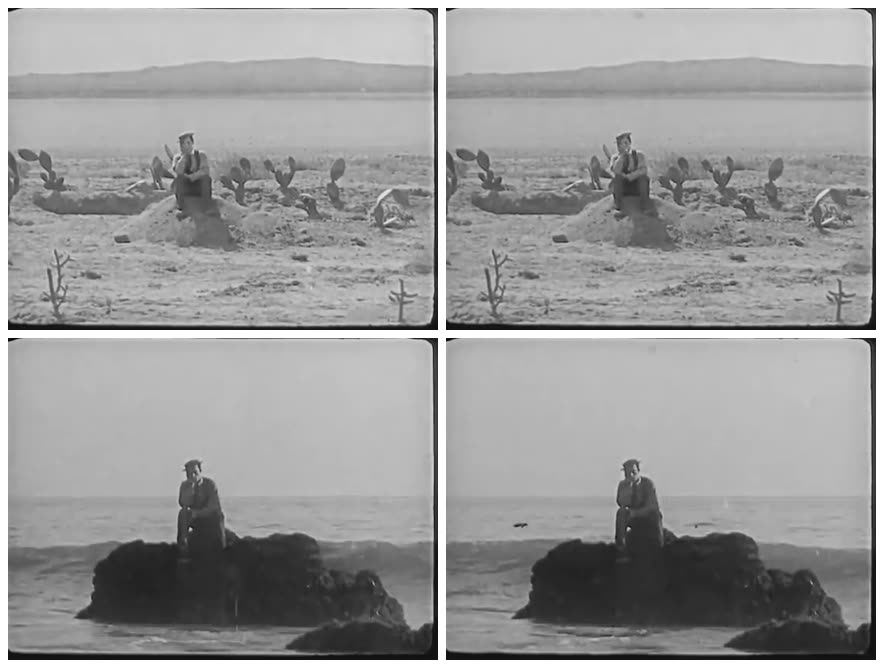
The crucial technical fact is that the figure does not move across the cut. His position in the frame, his scale, his posture and the stage of his action are preserved exactly; everything else is replaced. This is a match cut in the strictest sense, executed eight consecutive times, and on the evidence of the frames it is executed to within a few inches.5 Figure 12, the cut from the desert to the rock in the sea, makes the point most plainly of any plate here: he is sitting with his chin on his fist on a mound of sand, and then he is sitting with his chin on his fist on a wet rock, and the only way to tell that anything has happened is that the sand has become the Pacific.
Figures 6, 8 and 10 give three more of the eight, and the four-up form makes something visible that running the film at speed does not: the two frames before the cut and the two after are more alike, in everything to do with the human figure, than any two frames taken a second apart within a single shot. The match is tighter than the continuity it interrupts.
The desert, and the one world that fights back
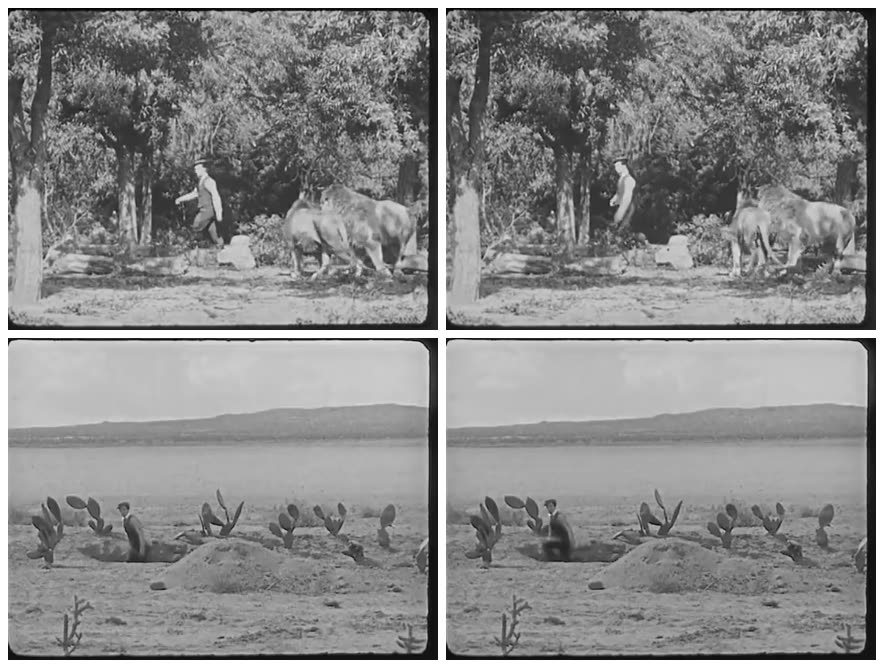
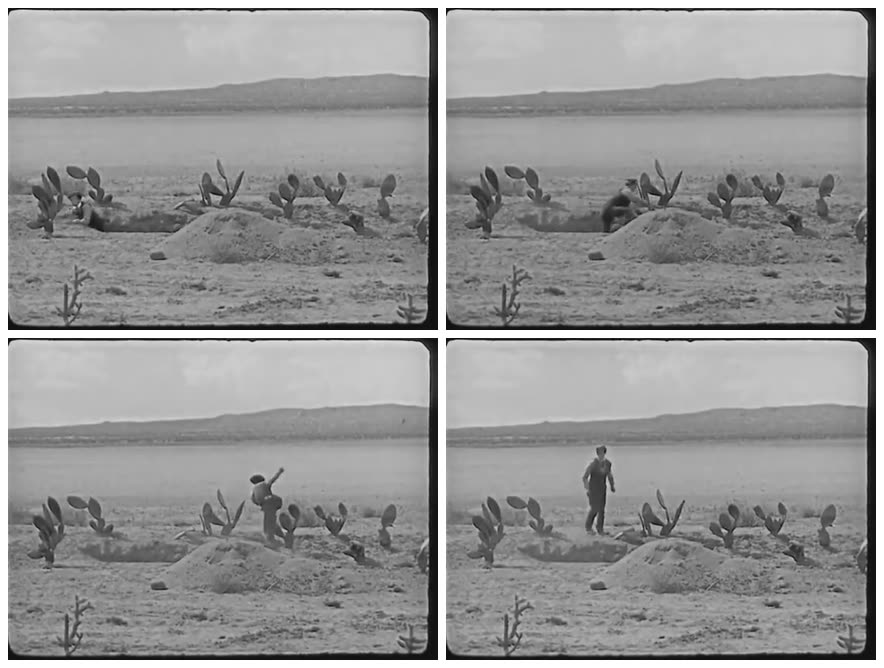
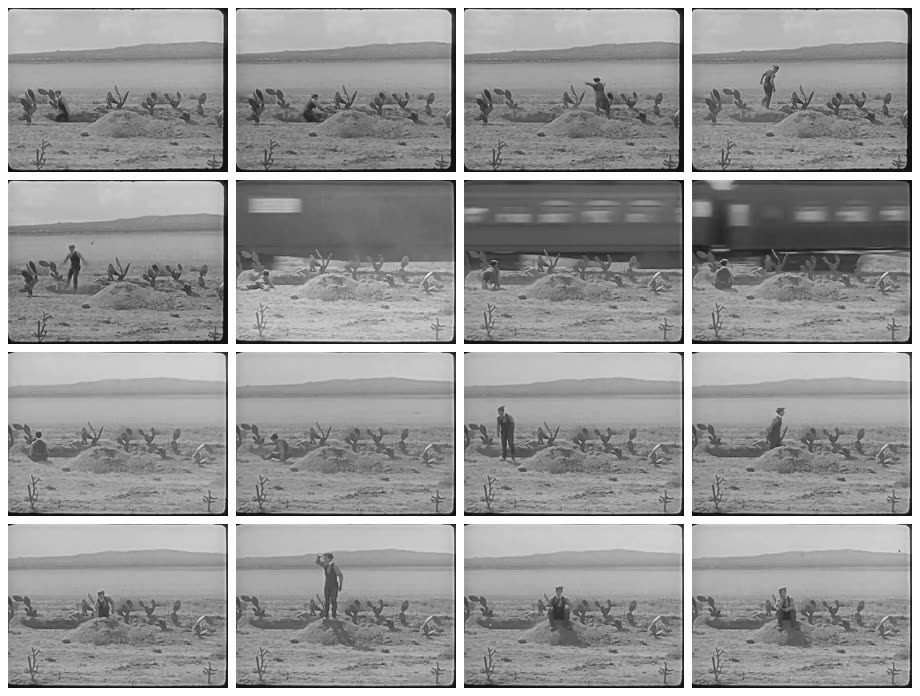
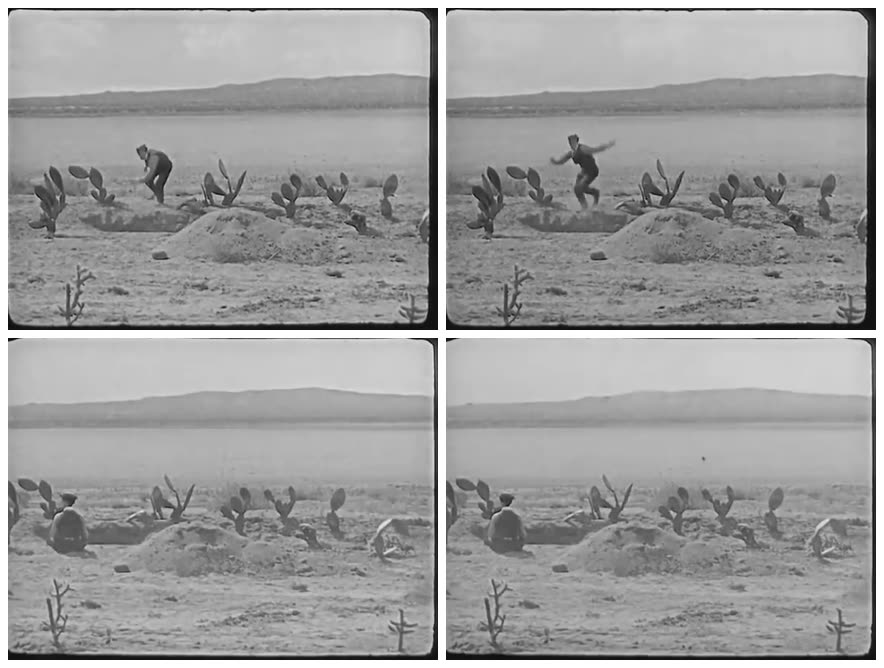
The fifth world is the exception that measures the rule. At Figure 14 the desert shot is laid out in sixteen frames across its full thirty seconds, and what it contains is the only passage in the sequence where the contents of a world, rather than the cut that produced it, does the violence. Keaton sits down in a shallow hollow between cactus mounds; a locomotive enters from the left and crosses the entire frame at speed, close enough that he flattens himself into the hollow; and when it is gone, he gets up and sits back down in exactly the posture he started in.
It is a Keaton train, with all the authority a Keaton train has, and it is beaten in a way the cuts never are: he survives it by lying still in a hole, which is a strategy available against trains and useless against editing. The thirty seconds are the length they are because a train needs track and time, where a cut needs neither. Figure 11 shows the four frames before the train arrives — the ordinary desert, the ordinary sitting-down — and the contrast with what follows is the clearest statement the sequence makes about the difference between an obstacle you can see coming and one you cannot.
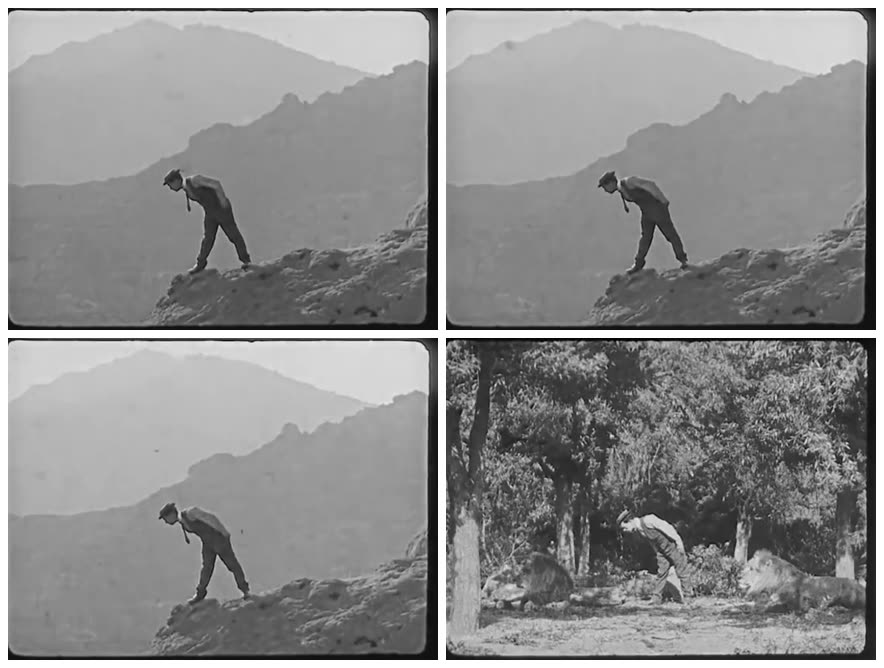
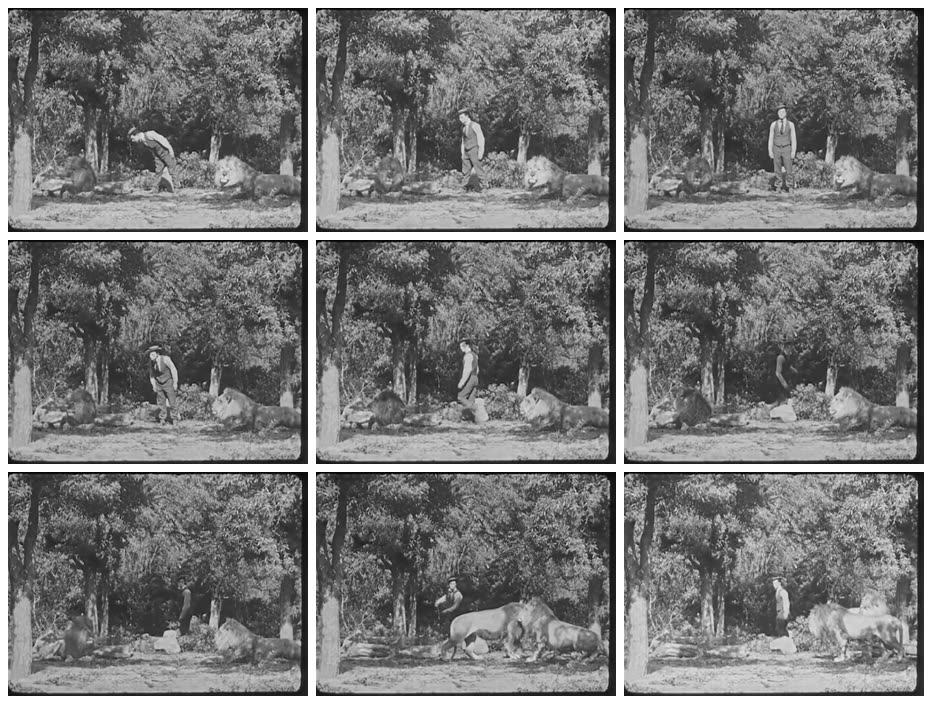
Figure 5 and Figure 9 are the two other worlds given in nine frames rather than four: the street, where the hazard is traffic and his response is to stand very still in it, and the lion's den, where the hazard is lions and his response is to leave with as little comment as possible. Both are built the same way. A world arrives; its characteristic danger is established in two or three seconds; Keaton registers it without alarm; and the cut removes the danger by removing the world, which is not a rescue but a fresh sentence.
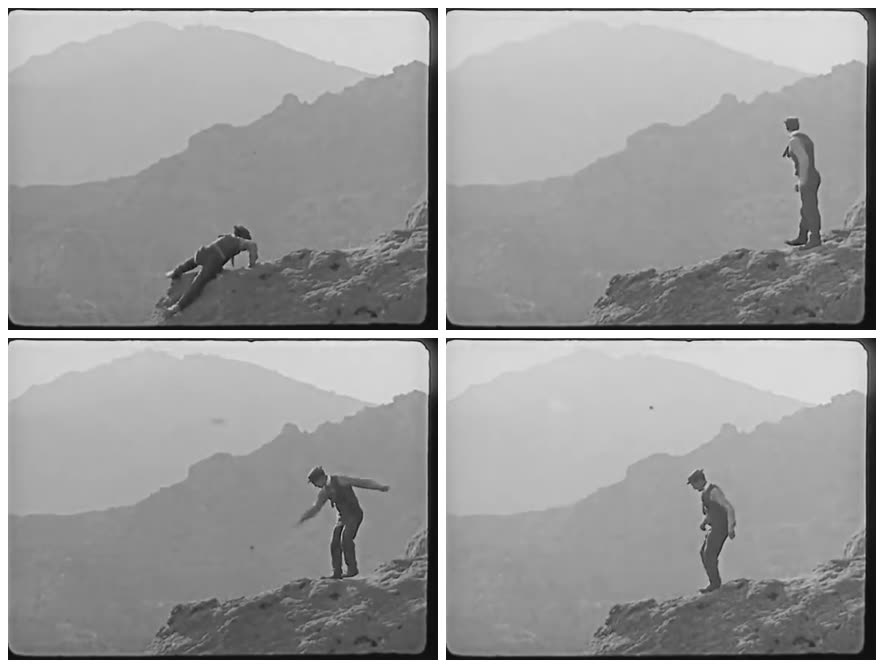
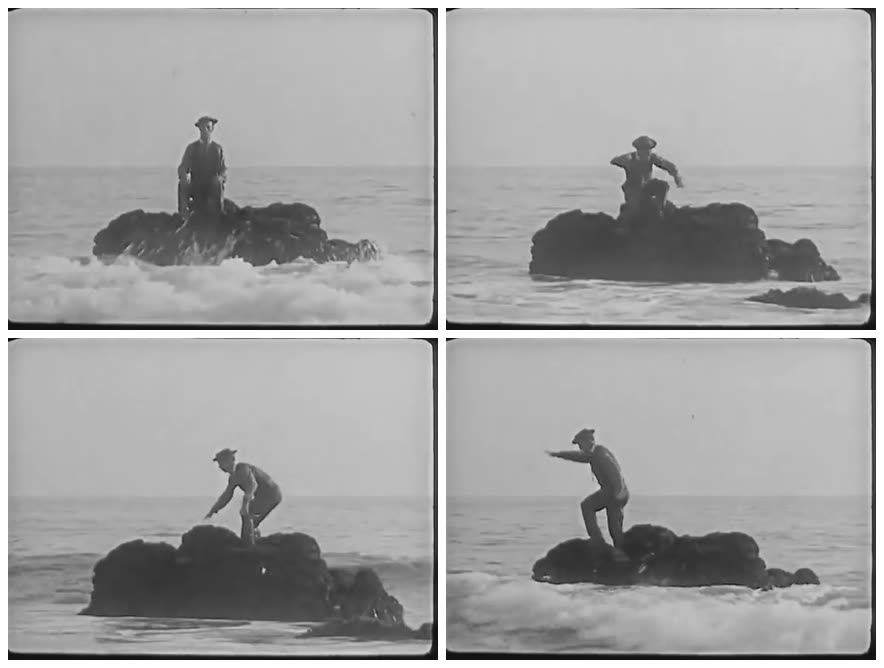
Figures 7 and 13 are the quietest plates here, and the pair makes a point the busier worlds obscure. On the cliff and on the rock in the sea the hazard is not an animal or a machine but the place itself, and in both Keaton's only available action is to stand on the single square yard that is not fatal and wait to be moved. These are the two worlds with no gag in them. They are also the two that most resemble the condition the whole sequence describes: a man in a location he did not choose, with nowhere to walk to, waiting for the next cut.
What the instrument sees, and what the theatre does to it
Because the sequence is a chain of matched cuts, I expected it to be difficult for an automatic shot-boundary detector — the kind that scores each frame against the one before and calls a cut when the difference exceeds a threshold. A match cut is, after all, a cut built to minimise exactly the quantity such a detector measures.6
That expectation was wrong, and the way it was wrong is the most interesting thing I found. Run against the screen alone — the picture cropped to the rectangle the film-within-the-film occupies — the detector finds the cuts easily. At a threshold of 0.30 it reports nine boundaries in the sequence and all nine are real, with nothing spurious; the only cut it misses is the last one. Keaton's matches are precise about the figure, but the figure is a small part of the picture, and a garden is not much like a desert. Table 2 gives the counts.
| Threshold | Reported | Real | Spurious | Where the spurious ones fall |
|---|---|---|---|---|
| 0.30 | 9 | 9 | 0 | — |
| 0.15 | 12 | 9 | 3 | street, desert, snowbank |
| 0.08 | 24 | 10 | 14 | chiefly the train7 |
Figure 19 shows two of the spurious boundaries as before-and-after pairs. Both are inside the desert shot, both are reported with high confidence, and both show the same desert on either side. The detector is not failing at the cuts. It is failing at the train, which moves more between two frames than a change of continent does.
Now the measurement that turned the argument round. If the detector is run over the whole frame — the screen with the theatre around it, as the film is actually composed — every one of those nine cuts registers at about half the magnitude it registers on the screen alone. The ratios run from 1.68 to 2.48, with a mean of 2.09.
| Cut into | Whole frame | Screen only | Ratio |
|---|---|---|---|
| the doorstep (closer camera) | 0.348 | 0.585 | 1.68 |
| the garden | 0.246 | 0.508 | 2.06 |
| the street | 0.243 | 0.452 | 1.86 |
| the cliff | 0.229 | 0.569 | 2.48 |
| the lion's den | 0.256 | 0.608 | 2.38 |
| the desert | 0.236 | 0.497 | 2.10 |
| the rock in the sea | 0.150 | 0.306 | 2.04 |
| the snowbank | 0.225 | 0.509 | 2.26 |
| the garden again | 0.416 | 0.870 | 2.09 |
| the parlour (out of the dream) | 0.153 | 0.081 | 0.53 |
The reason is arithmetic rather than mysterious: two-thirds of the picture is a theatre that does not change, so two-thirds of every cut is a cut from a thing to itself. But the consequence is not arithmetic at all. Keaton's staging halves the measurable size of his own cuts. The decision to show the dream as something seen from a seat — the decision that gives the sequence its whole comic position — is also the decision that makes each of its ruptures quantitatively smaller. He makes the most violent cuts of his career and then frames them so that most of the frame is undisturbed.
The first and last rows of Table 3 are the proof that this is a property of the staging and not of the print, because they are the two boundaries at which the theatre itself changes, and they are the two that depart from the pattern. The cut out of the dream, back to the parlour, removes the auditorium altogether, and it is the only cut in the passage whose whole-frame score exceeds its screen-only score — a ratio of 0.53, against a mean of 2.09 for the eight world cuts. The cut into the doorstep shot is the other: it is not a change of world at all but a cut to a closer camera position in the same auditorium,3 so the theatre changes scale across it, and it returns the lowest ratio of the nine at 1.68. When the auditorium is what changes, the auditorium is what the instrument sees.
That second boundary is also where the camera takes up its station. From the cut at 19:35.55 until the dream ends two minutes later, the framing does not alter by a pixel: the same proscenium, the same orchestra rail, the same backs of the same heads, through a garden, a street, a cliff, lions, a desert, an ocean and a snowbank. Keaton found the seat he wanted the audience to sit in, cut to it once, and then never mentioned it again.
The return
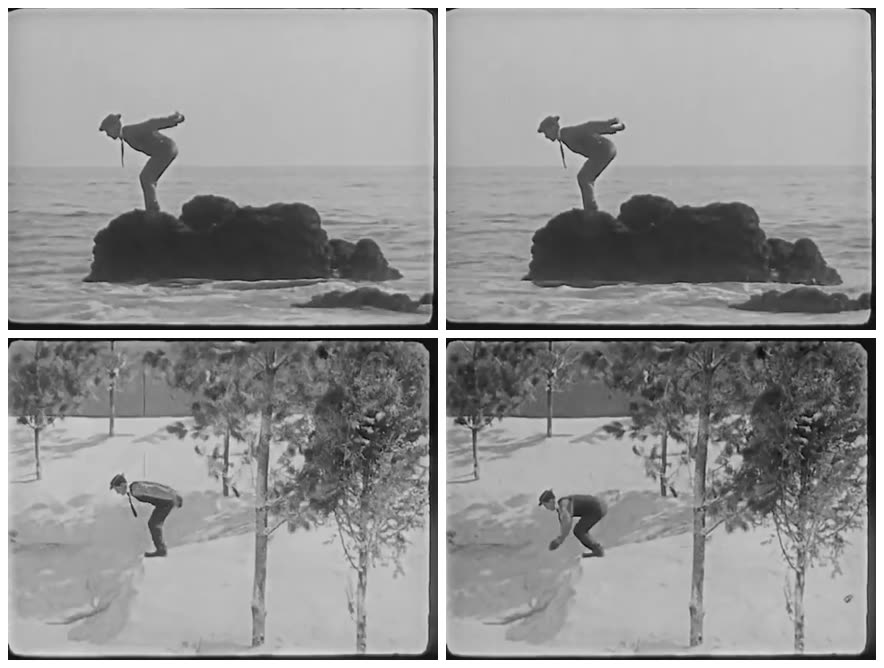
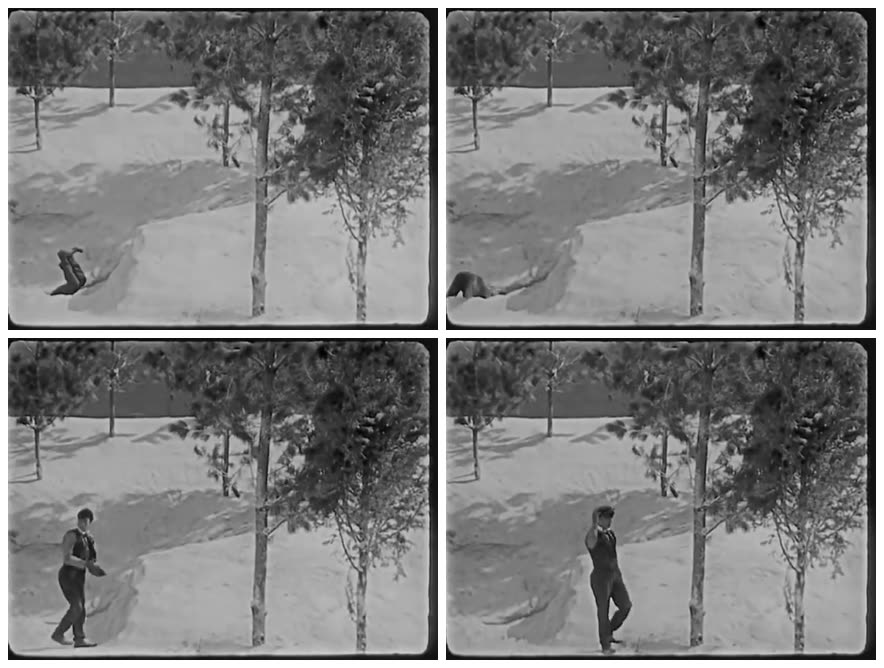
The eighth world is the first world. After the snowbank — Figure 15 brings him to it head first, diving off the sea rock into a drift, and Figure 16 holds him there long enough to be cold — he leans against a tree, and the cut (Figure 17) returns him to the garden wall he was thrown into at the start, with the same trees, the same stone plinth, the same painted sky. Figure 18 sets the first world and the last side by side.
Two things are accomplished by that. The first is formal: it closes the sequence, and it closes it by rhyme rather than by resolution, which is the only ending available to a passage whose premise is that endings can be revoked by a cut. The second is cruel, and is the better joke. Returning him to the garden does not restore anything. It demonstrates that the last hundred and eighteen seconds have been a circle, that he has travelled through five continents and two oceans and arrived exactly where he was thrown, and that the edit was never taking him anywhere. In the final cell of Figure 2 the last world and the first are the same wall. He has been moved eight times and gone nowhere.
It is worth saying that none of this is what the sequence is for, in the sense of what it is doing in the film. Sherlock Jr. is a picture about a man who wants to be someone more competent than he is, and the dream is where he gets to be.8 The transformation passage is the price of admission: before the film will let him be the great detective, it puts him through two minutes of demonstrating that he does not control the medium he has walked into. He has to be thrown through eight worlds first, by the only antagonist in his filmography that he never once gets to look at. Which is, when you consider that he was both the man on the screen and the man who made the cuts5, a reasonably complete account of what it is to direct yourself.
Note on the print and the measurements
Everything above is measured from a single transfer, and the numbers are properties of that transfer before they are properties of the film.1 Durations are given in the transfer's own time base;2 the shot boundaries come from scene scores confirmed by eye;4 and the plates are frame enlargements cropped, except where stated, to the screen rectangle.3 Two claims here could be overturned by a better print, and I would like to say which: the exact cut times, which a frame-accurate source would shift by up to a twenty-fourth of a second, and the shot-length shape described after Table 1, which depends on the desert being a single shot. It is a single shot in this transfer. The surveying story, meanwhile, I have left where I found it.5
Plates
Notes
The transfer used throughout is the copy held at the Internet Archive under the identifier sherlockjr1924_201909, 960 by 720, running 44 minutes 33.85 seconds, carried at 23.976 frames per second, and marked there with the Creative Commons Public Domain Mark. Sherlock Jr. was released in 1924 and is in the public domain in the United States; every plate in this piece is a frame enlargement from that file. A restored edition would carry its own claims, and none is used here. ↩ ↩
Durations are given in the transfer's time base, not in 1924's. Silent camera and projection speeds of the period were variable and generally below 24 frames per second, so a passage timed from a 23.976 transfer is shorter than the same passage would have run in a theatre that year — by a margin no measurement of the file can recover. Nothing in this piece turns on the absolute figures: the comparisons between shots, which are what the argument uses, are unaffected by a uniform change of speed. ↩ ↩
Measured on each of the eight world shots by scanning outward from the centre of the frame to the edges of the surrounding mask, the screen occupies a rectangle 550 pixels wide and 410 high with its top-left corner at (216, 28). The sequence is preceded by a wider view of the same auditorium, taking in the side walls and the exit signs, and the cut at 19:35.55 is the move between the two; after it the framing is constant to the end of the dream. What is not constant is the size of the projected image within the screen: the two garden inserts are matted smaller than the rest and do not fill it, so plates containing them carry a black surround rather than being enlarged to match. Plates are cropped to the screen rectangle except Figure 1, which is about the theatre and therefore uses the whole frame. ↩ ↩ ↩
Shot boundaries were found by computing a per-frame scene score over the cropped screen rectangle and taking the maxima above a threshold, then confirming each by inspecting the two frames either side. Nine boundaries survive at a threshold of 0.30 and all nine are genuine; the tenth real boundary, the cut back to the parlour, appears only at 0.08, because the frame it cuts to is dark. Every boundary in Table 1 was confirmed by eye. ↩ ↩
The production story usually attached to this sequence is that the matched positions were set with surveying instruments, so that Keaton could be returned to the identical spot in the frame as the backgrounds were changed behind him. The accounts disagree about whose instruments: some credit the cameraman Elgin Lessley, others the cameraman Byron Houck. I have not been able to settle it from a primary source, and record the disagreement rather than choosing between the two — the frames establish that the matching was done to a precision that wants an explanation of this kind, which is a separate claim from knowing who did it. ↩ ↩ ↩
A scene score of the kind used here is a normalised measure of how much a frame differs from its predecessor, aggregated over the picture. It is a proxy for "a cut happened" and not a detector of cuts as such, which is exactly why it is informative to run it over two different crops of the same film: the quantity it reports depends on how much of the frame is doing the changing, and that is a compositional fact about the shot rather than a fact about the edit. ↩
Fourteen of the twenty-four boundaries reported at a threshold of 0.08 fall inside a shot. Nine were checked frame by frame and show the same setting on both sides. Four of the remaining five fall in the twelve seconds during which the locomotive crosses the desert; the last is in the street, where traffic passes close to the camera. The pattern is consistent: the measure is triggered by movement within the world, and the only thing in this sequence that moves hard is machinery. ↩
The dream does let him be the detective, at length and with great success, which is what the rest of the reel is for. The transformation sequence is not part of that story and does not advance it; it is the threshold he is made to cross first, and it is the only passage in the film in which the dream is hostile to him. ↩
Shot By Shot is published by Exploded Views Media. Plates are frame enlargements from a public-domain print of Sherlock Jr. (1924), reproduced here for criticism and comment. Measurements and tables may be reused with attribution.